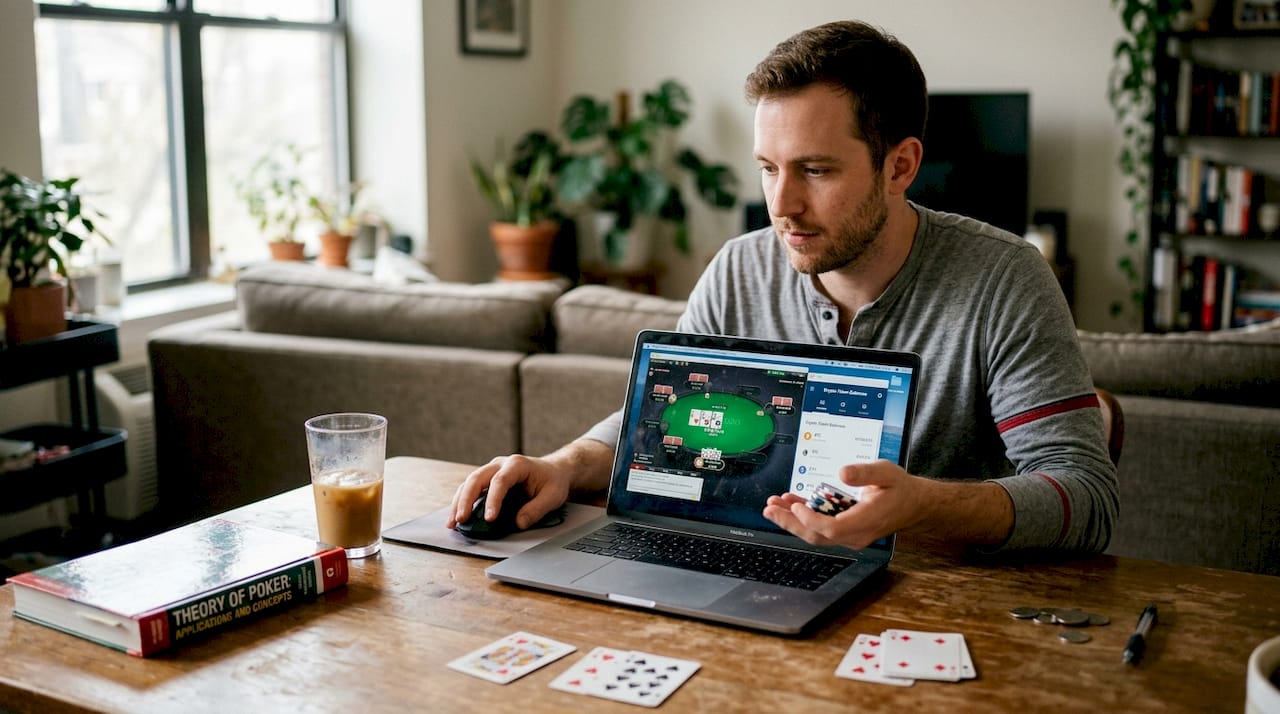
How to Access 25% More Freeroll Tournaments: A Step-by-Step Poker Strategy for 2026
|
0
min read

How to Access 25% More Freeroll Tournaments: A Step-by-Step Poker Strategy for 2026
Thousands of players participate in free-to-play blockchain poker every week, yet the majority walk away without meaningful rewards. The difference between those who consistently cash and those who do not rarely comes down to raw talent — it comes down to structure. This guide provides a complete, step-by-step poker strategy for 2026 that shows you how to survive longer, accumulate chips at the right moments, and take full advantage of FreerollPoker.co.uk's platform to unlock 25% more access to high-reward tournaments.
TABLE OF CONTENTS
What You Need Before You Start
Step 1: Early Tournament Play — Discipline and Position
Step 2: Mid-Tournament Play — Controlled Aggression
Step 3: Late Tournament Play — Payout Awareness and Final Table Tactics
Managing Your Tournament Schedule Like a Bankroll
How to Use FreerollPoker.co.uk Features to Your Advantage
Mistakes That Cost Players the Most
What to Expect: Realistic Timelines and Benchmarks
Frequently Asked Questions
KEY TAKEAWAYS
Point | Details
Play tight early | Restricting starting hands to fewer than 20% in early levels dramatically reduces early bust-outs.
Shift gears mid-tournament | Controlled aggression from position builds the stack you need to compete at the final table.
Treat your time like a bankroll | With 100 or more scheduled entries, variance smooths out and improvement compounds.
Upgrade your avatar | Avatar upgrades on FreerollPoker.co.uk unlock 25% more entries into premium freeroll events.
Fix your leaks first | Weak folding discipline and tilt-driven decisions are responsible for up to 40% of preventable losses.
WHAT YOU NEED BEFORE YOU START
Strong results in freeroll tournaments begin long before the first hand is dealt. The foundation matters as much as the strategy itself.
Start by ensuring you have a firm grasp of hand rankings, position, and basic pot odds. Players who skip this step find themselves making instinctive decisions rather than calculated ones, which is expensive even in free-to-play formats.
Register on FreerollPoker.co.uk (https://freerollpoker.co.uk) and set up an Ethereum wallet to receive your winnings. Blockchain payouts are processed directly to your wallet, so having this ready before you cash is essential — do not leave it until after your first deep run.
Beyond the technical setup, you need:
A stable internet connection — disconnections at critical moments are costly
Set time windows for play, not open-ended sessions
A tracking document or app to log every result and decision point
Willingness to review losses honestly and adjust
Patience — meaningful progress in tournament poker takes months, not days
STEP 1: EARLY TOURNAMENT PLAY — DISCIPLINE AND POSITION
[IMAGE: Close-up of poker chips being stacked carefully at a table]
The opening stages of any freeroll tournament are littered with players taking unnecessary risks. Fields are large, chips are relatively deep, and the temptation to gamble early is high. Resisting this temptation is the single most important early-game skill you can develop.
Your objective in the first three blind levels is simple: survive, observe, and accumulate only when the situation is clearly in your favour.
Follow this early-game approach:
Keep your opening range below 20% of all starting hands.
Focus on high-value hands — premium pairs (tens or better) and ace-king suited.
From late position, you can open around 30% more hands than from early position.
When a player shows aggression and you hold a marginal hand out of position, fold without hesitation.
Use the time you are not in hands to study how opponents are playing.
The informational edge that position provides cannot be overstated. Acting after your opponents gives you a clearer picture of hand strength before you commit chips. Use late position to take small pots cheaply and avoid bloated pots when out of position.
Pro Tip: Make a mental note of any player who raises frequently from under the gun or early position. These players are opening too wide and will find themselves in difficult spots. When you hold a strong hand against them, you are likely ahead.
One of the most common misconceptions in tournament poker is that building a large stack early gives you a decisive advantage. The data does not support this. Players who survive the early stages with average stacks consistently outperform those who gamble for big early stacks and bust. Patience is a strategic asset.
STEP 2: MID-TOURNAMENT PLAY — CONTROLLED AGGRESSION
[IMAGE: Focused player leaning forward at a poker table, chips in hand]
Once the field has thinned and blinds have increased, passive play stops working. The players who reached this stage with chips earned them — and they are paying attention. Your strategy must evolve accordingly.
The mid-tournament phase is where matches are really won or lost. A player who navigates this stretch well arrives at the final table with genuine options. A player who plays passively arrives short-stacked and desperate.
Apply these adjustments as the tournament progresses:
Widen your opening range from late position to around 25–30% of hands.
Identify players who are folding too often to pre-flop raises and attack their blinds regularly.
When you connect strongly with the flop, bet for value — do not slow-play in multi-player pots.
Against opponents who consistently check back and show weakness, well-timed bluffs become profitable.
Avoid confrontations with deep-stacked, aggressive opponents unless you have a clear advantage.
Reading table dynamics is as important as reading individual hands. Some tables are passive and easy to steal from. Others are aggressive and require tighter play. Adjusting your strategy to the table you are actually at — rather than a theoretical one — is what separates consistent performers from one-time deep runners.
Pro Tip: Following a big pot win, tighten back up briefly. Your opponents are watching and many will look to reclaim chips from you quickly. Make them pay for that instinct by holding strong hands when they come after you.
Tilt is most dangerous in this phase. The pots are bigger and the swings feel more significant. Losing two large pots in quick succession can destabilise even disciplined players. If that happens, step away for five minutes. The tournament will still be there. Your decision-making quality is worth more than the hands you miss.
STEP 3: LATE TOURNAMENT PLAY — PAYOUT AWARENESS AND FINAL TABLE TACTICS
[IMAGE: Intense final table scene with chips and cards under bright lighting]
Everything changes near the bubble. Players who were loose and aggressive earlier suddenly tighten up dramatically. Short stacks become desperate. Medium stacks become cautious. The payout structure begins to govern decision-making as much as chip equity.
Understanding this shift — and exploiting it — is how skilled players turn deep runs into actual cashes.
Use these tactics in the late stages:
Against medium stacks who are clearly trying to ladder up in payouts, raise frequently. They will fold more than they should.
Tighten your own range when short stacks at the table are close to elimination — let them bust before you take unnecessary risks.
Learn the basics of Independent Chip Model (ICM) thinking. Folding a decent hand to preserve your tournament equity is often the correct play near pay jumps.
In late position with a big stack, your ability to apply pressure is at its peak — use it consistently.
As a short stack, do not blind away. Identify the best spot available and commit fully rather than letting your stack erode to unplayable levels.
Payout structures fundamentally alter what constitutes a correct decision. A call that would be straightforward in a cash game becomes questionable at a final table when a fold means moving up a pay grade. The players who internalise this — rather than simply playing chip equity — consistently finish higher.
MANAGING YOUR TOURNAMENT SCHEDULE LIKE A BANKROLL
[IMAGE: Notebook and laptop open on a desk with tournament results being tracked]
In cash poker, bankroll management is about money. In freeroll poker, it is about time and consistency. The principle is identical: you need enough volume to let your edge overcome short-term variance.
Treat each week's tournament schedule as your bankroll allocation. Enter at least 15 to 20 events per week and commit to reviewing your results every month. Patterns that are invisible across five tournaments become obvious across fifty.
Structure your approach this way:
Log every tournament: date, field size, finishing position, and any prize won.
After each session, note one decision you are uncertain about and research it.
Set a weekly entry target and stick to it regardless of recent results — do not chase losses by over-playing.
Avoid scheduling sessions late at night or during high-stress periods. Mental fatigue is a significant performance leak.
Give yourself permission to step away from a session that is going badly without playing catch-up.
A realistic process goal for a developing player is 20 tournaments per week with disciplined strategy throughout. The corresponding results target — cashing in roughly 10% of entries — will follow naturally as your skills develop. Chase the process, not the results.
Your time is the resource being invested here. Treat it accordingly.
HOW TO USE FREEROLLPOKER.CO.UK FEATURES TO YOUR ADVANTAGE
[IMAGE: Screenshot-style graphic showing a poker avatar upgrade interface]
Technical skill at the poker table is only part of the equation. Players who understand and use FreerollPoker.co.uk's (https://freerollpoker.co.uk) platform features gain a measurable edge before a single card is dealt.
The most significant advantage available to UK players on the platform is avatar upgrades. Upgrading your avatar unlocks access to 25% more high-reward freeroll tournaments. This is not a cosmetic benefit — it directly increases the number of premium events available to you, which means more opportunities to win real Ethereum rewards over time.
Here is how to maximise the platform's features:
Invest in avatar upgrades strategically, prioritising traits that unlock the highest-tier tournament access relative to their cost.
Align major upgrades with upcoming tournament series to make the most of expanded access immediately.
Monitor the leaderboard regularly — your position relative to other players is the clearest real-time signal of whether your strategy is working.
Join the FreerollPoker.co.uk Discord community. The discussions there provide practical insights that are difficult to find elsewhere, particularly around how experienced players approach specific tournament formats.
Review which upgrades other top leaderboard players have invested in — this can guide your own upgrade path.
The tiered access system rewards players who invest in the platform. Standard accounts access the standard freeroll schedule. Upgraded accounts access premium events with larger prize pools and, importantly, smaller fields of similarly invested players. That competitive dynamic is worth understanding and acting on early.
MISTAKES THAT COST PLAYERS THE MOST
[IMAGE: Frustrated poker player with head in hands at a table]
Most freeroll losses are preventable. The analysis is consistent across skill levels: poor folding decisions and emotional reactions to variance account for up to 40% of avoidable tournament exits. Fixing these two areas alone will move most players from break-even to profitable.
The most damaging habits to eliminate:
Playing ace-rag and similar weak aces from early position — these hands are far less profitable than they appear and generate difficult spots post-flop.
Calling pre-flop raises with small pocket pairs from out of position — without the right implied odds, these calls are consistently losing plays.
Revenge poker after a bad beat — losing a large pot is not a reason to play the next ten hands. It is a reason to take five minutes away from the screen.
Ignoring position when deciding whether to continue with a marginal hand — position changes the value of every hand significantly.
Continuing with the same approach when it is clearly not working against a specific opponent or table dynamic.
When you face a raise from a tight player and you are holding a hand like king-jack offsuit from early position, folding is not weak — it is correct. Strong players understand that protecting chips for better spots is more valuable than contesting every pot.
Build a personal rule around tilt: two significant losses within a ten-minute window means a mandatory break. No exceptions. Walk away from the screen, get some water, and do not return until you are genuinely ready to play your best. The habit alone will save more chips over time than most strategic adjustments.
If you find yourself consistently losing in the same tournament phase, treat it as diagnostic information. Early losses point to hand selection issues. Mid-tournament losses suggest aggression timing problems. Late tournament losses often indicate ICM misunderstandings. Identify the pattern and address it directly.
WHAT TO EXPECT: REALISTIC TIMELINES AND BENCHMARKS
[IMAGE: Graph or chart showing upward progress over time, poker chips in background]
Setting realistic expectations is essential. Players who expect to be profitable within their first month invariably become frustrated and abandon strategies before they have had time to work. The trajectory below reflects what disciplined, improving players typically experience.
Timeframe | Cash Finish Rate | Average ROI | Leaderboard Movement | What You Are Developing
Months 1–3 | 5–8% | Roughly break even | Minimal change | Fundamentals, variance tolerance
Months 4–6 | 8–10% | Small positive return | Gradual climb | Cleaner hand selection, better reads
Months 7–9 | 10–12% | Moderate positive return | Steady upward movement | Aggression timing, opponent modelling
Months 10–12 | 12–15% | Strong positive return | Significant climb | Full phase mastery, consistent exploitation
A cash finish rate of 10–15% is a strong result in freeroll fields that regularly exceed 500 players. Breaking the 15% threshold consistently suggests you are ready for higher-stakes events.
Return on investment in freerolls is measured in time, not entry fees. A useful benchmark is the Ethereum reward value you generate per hour of play. Players generating the equivalent of £8–£12 per hour in blockchain rewards are playing at a profitable level that justifies continued commitment.
Leaderboard movement is the most honest signal of genuine improvement. Moving from the bottom half to the top half of the FreerollPoker.co.uk leaderboard (https://freerollpoker.co.uk) within six months indicates your strategy is working. Reaching the top quartile within twelve months puts you among the platform's strongest consistent performers.
Do not underestimate the compounding effect of Ethereum payout efficiency. Faster reinvestment of winnings — enabled by platforms with streamlined blockchain payout systems — accelerates your overall progress.
FREQUENTLY ASKED QUESTIONS
What starting hands should I prioritise in freeroll tournaments?
In the early stages, focus on premium hands — pocket pairs of tens or better, ace-king suited, and ace-queen suited. As the tournament progresses and you move to later position, you can profitably add more hands to your range. The key is matching your opening range to your position and the action before you.
Do avatar upgrades on FreerollPoker.co.uk make a real difference?
Yes. Upgraded avatars unlock access to 25% more high-reward freeroll tournaments on the platform. Over the course of a month of regular play, that translates directly into additional prize-winning opportunities. The access advantage alone makes upgrades worthwhile for serious players.
How long before I can expect to profit consistently?
Most players begin to see consistent positive returns between six and twelve months of disciplined play. The key variable is not talent — it is consistency of effort and willingness to analyse and correct mistakes rather than repeat them.
Is FreerollPoker.co.uk available to players across the UK?
Yes — FreerollPoker.co.uk (https://freerollpoker.co.uk) is built specifically for the UK market, offering daily freeroll tournaments with real Ethereum rewards and no deposit requirement for any eligible UK player.
How do I stop tilt from ruining my sessions?
The most effective method is a pre-committed rule rather than an in-the-moment decision. Decide in advance that two significant losses within ten minutes means you leave the session. When it happens, follow the rule automatically. Over time this single habit protects more chips than almost any strategic adjustment.
What is the best way to track progress in freeroll tournaments?
Maintain a simple log of every tournament you enter: date, number of players, finishing position, and prize. Review this log monthly. Look for patterns by phase — where you are consistently losing tells you exactly where to focus your improvement efforts.
PLAY ON FREEROLLPOKER.CO.UK — FREE TO ENTER, REAL ETHEREUM REWARDS
FreerollPoker.co.uk (https://freerollpoker.co.uk) gives UK players everything covered in this guide: daily freeroll tournaments, real Ethereum payouts direct to your wallet, and an avatar upgrade system that unlocks 25% more premium tournament access.
No deposit is required. Your first tournament costs nothing to enter and pays out real blockchain rewards.
The platform is structured to support players at every stage — from beginners learning the fundamentals through to experienced players competing in exclusive high-reward events. Leaderboards, community Discord, and a growing player base make it the most complete free-to-play poker environment available to UK players in 2026.
Start playing today: https://freerollpoker.co.uk
RECOMMENDED READING
How to Win Freeroll Poker: Master Every Tournament Step
https://freerollpoker.co.uk/blog/how-to-win-freeroll-poker
7 Ways to Earn in Free Poker and Boost Your Rewards
https://freerollpoker.co.uk/blog/7-ways-to-earn-in-free-poker
7 Essential Poker Strategy Checklist Tips for Free-Play Wins
https://freerollpoker.co.uk/blog/poker-strategy-checklist
7 Ways to Earn Real Rewards on Poker Platforms
https://freerollpoker.co.uk/blog/7-ways-to-earn-real-rewards